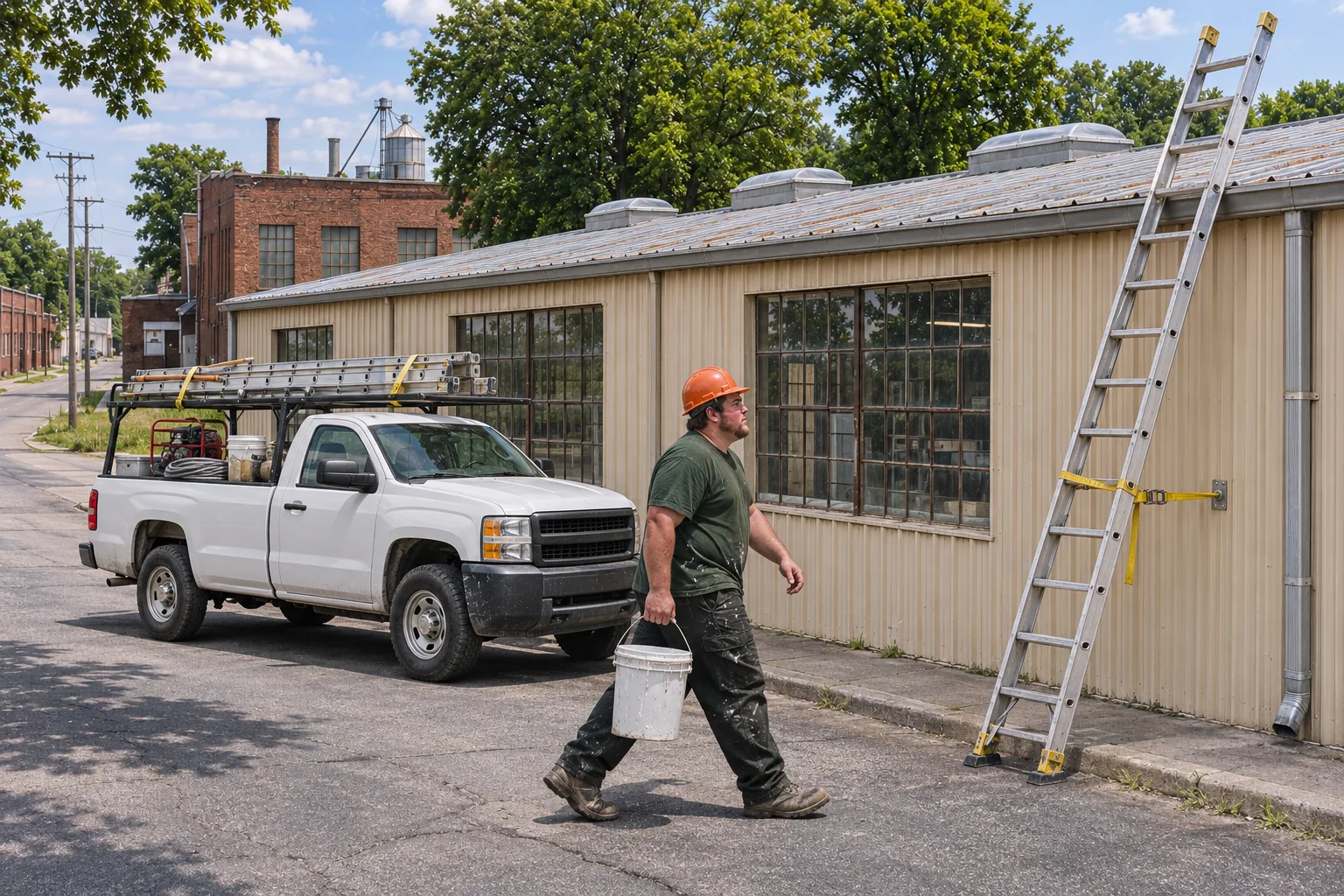
Metal Roof Coating for New Castle Businesses
Steel roofs on plants and shops get rust primer, sealed screws, and a two-coat finish.
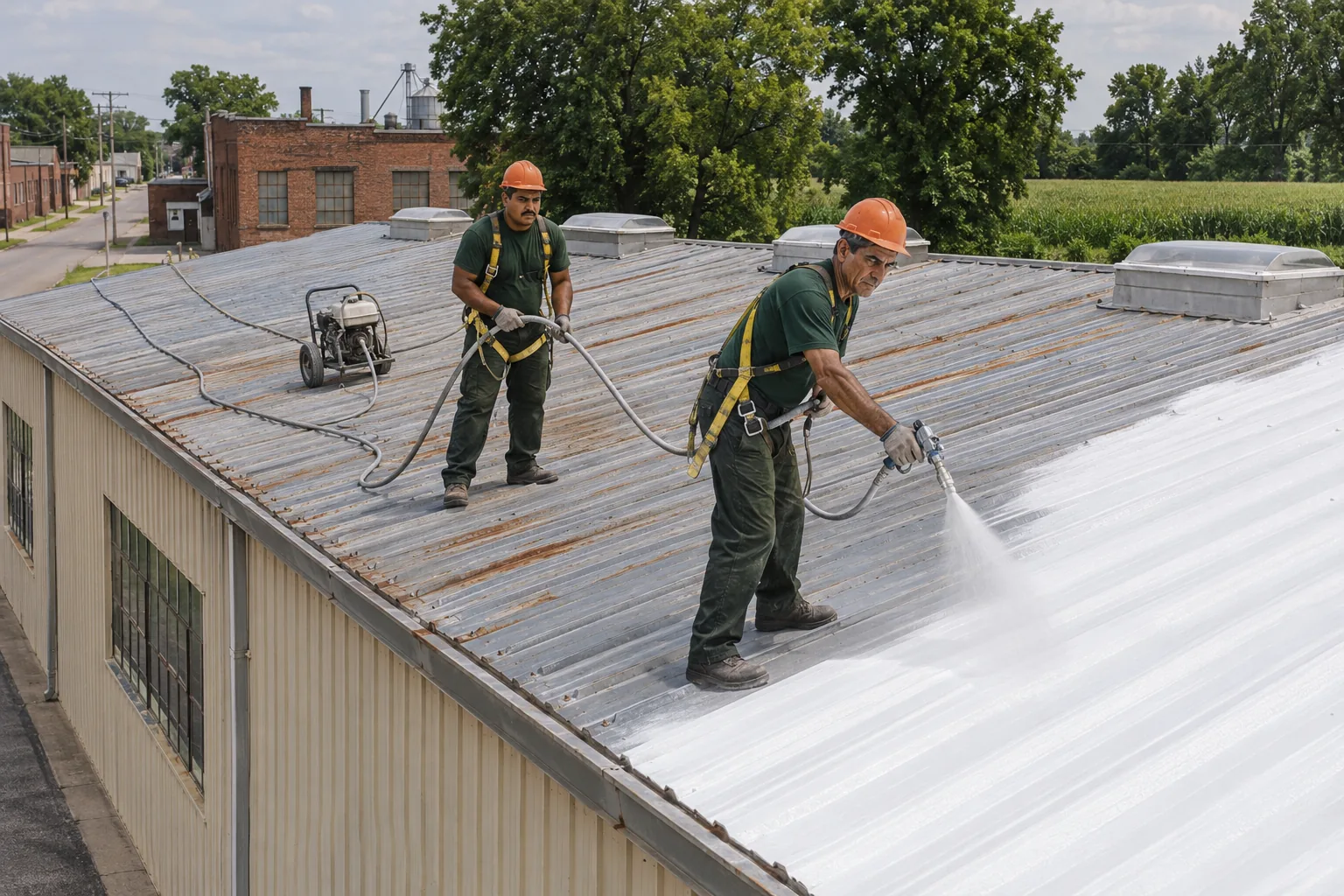
As a New Castle metal roof coating contractor, we coat steel roofs on plants, shops, and warehouses in sections, so the floor below keeps working.
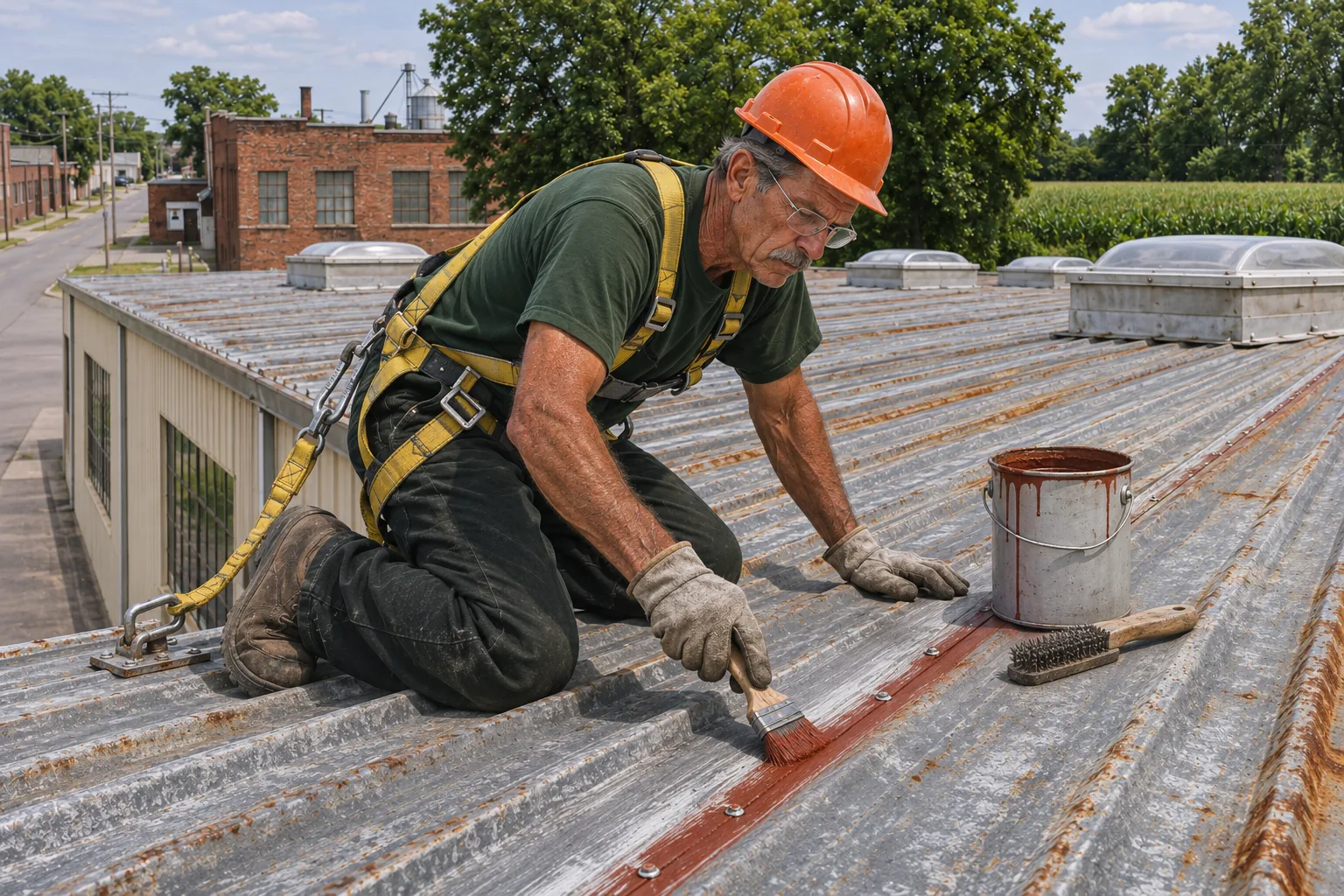
New Castle metal roof coating on a working plant starts with a map of the roof by bay. We match each section to the line below it and coat a bay when that area can handle a short noise or odor window.
Exhaust fans and process vents wear the roof faster around their curbs, so those spots get the heaviest prep. Fan shutdowns are timed with your maintenance crew ahead of the work.
Plant roofs show wear in patterns tied to what runs underneath. These three come up most in New Castle.
A leak that lands on equipment usually comes from a lap directly upslope, where vibration has opened the sealant.
Laps near heavy machinery get new sealant and fabric, then extra coating thickness across the joint.
Dark runs on purlins near exhaust fans show water mixing with process residue on its way in.
Residue and heat break down the finish around fan curbs, so those areas are scrubbed, primed, and coated heavier.
Upper mezzanines that bake in summer sit under dark, faded panels.
A white topcoat over the cleaned steel reflects that afternoon sun.
Icicles and a wet floor near the dock wall in late winter come from snowmelt refreezing in a long gutter run.
Meltwater backs up under panel ends when the gutter freezes, so end laps and gutter seams are sealed before coating.
For a working plant, coating keeps the roof sealed while the floor keeps going.
Bays are coated one at a time while production continues below.
Every screw head on the roof gets sealant and a check for tightness.
Fan and vent curbs get fabric and extra coating thickness.
Primed rust at laps and panel ends stays dry under the coat.
A white topcoat cuts the heat building up under the roof deck.
Photos and thickness readings are logged for each bay we finish.
Existing panels stay put, so no scrap steel lands near the lines.
A future recoat can be planned around the same shutdown windows.
Plant roofs here are mostly steel, with some flat sections over offices. Each gets the system that fits it.
Steel roofs on plants and shops get rust primer, sealed screws, and a two-coat finish.
Low office sections that hold water after rain take silicone.
Sloped storage roofs that drain fast take acrylic with an easy recoat path.
Shops that leak and lose heat can take spray foam with a topcoat.
Office fronts with flat, intact shingles take a shingle-rated coating.
Drips on equipment are hard to wait out until the next shutdown. Call and we will set up a roof walk to find the lap or curb letting water in.
Phone: (463) 466-9855
Plant work runs on your schedule, so every step is booked around the floor.
We walk each bay with your maintenance lead, meter the insulation, and mark laps, curbs, and screws.
Each roof section gets a date tied to the line below, with fan shutdowns arranged in advance.
Washing removes dirt and process residue so primer and coating bond to bare paint and steel.
Rust gets primer, screws get sealed, and laps and curbs get fabric before the coats.
Coats go on to the specified thickness, checked with wet film readings bay by bay.
We also coat roofs in Muncie and the towns listed here. Building somewhere else? call us or send us a message.
What plant and shop owners in New Castle ask before a coating job.
Yes. Industrial and commercial metal roofs in New Castle get the same inspection as any job: rust, screw condition, seams, and drainage. We clean, treat, and seal those details, then apply silicone where water sits or acrylic on sloped panels that drain well.
The published coating range is about $2.50 to $4.00 per square foot, with replacement around $5 to $8. On a plant, scheduling around shifts, the number of fan and vent curbs, and the amount of rust treatment decide where a roof lands in that range.
Yes. Small shops and single-bay buildings in New Castle get the same prep as a large plant, just over fewer squares. A short roof walk tells us whether the panels are ready to coat or need screw and lap repairs first.
In most cases it can. We coat one section at a time, keep lifts clear of forklift traffic, and plan any fan or air handler shutdown with your team ahead of time. Low-odor products are used near intakes that feed occupied spaces.
Old patches get checked for adhesion. Solid ones are cleaned and coated over, while loose or cracked patches come off and the area is resealed before the new coat. Mixed patch materials sometimes need a primer so the coating grips each one.
Only for the short time we coat right beside them. Fan curbs and the panels around them get the heaviest prep, and we set each shutdown with your maintenance crew so it lines up with a break or a planned stop in production.
Yes, once it is removed. Residue from exhaust keeps coatings from bonding, so those areas get a stronger cleaner and a scrub before rinsing. An adhesion test on a cleaned patch confirms the surface is ready before the full roof is coated.
Get a ballpark coating range for the plant or shop roof, or call to walk the roof with your maintenance lead.